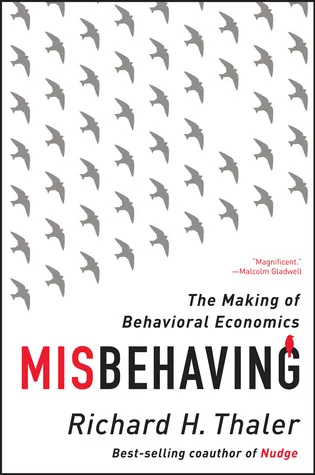
Richard Thaler chronicles the evolution of behavioral economics by challenging the standard model of the Rational Homo Economicus. He argues that real people are predictably irrational, suffering from cognitive biases such as the endowment effect, mental accounting, and loss aversion. The book details his career-long effort to integrate psychological realism into financial theory, highlighting specific studies on sunk costs and the fairness of price gouging. Thaler recounts his collaborations with Daniel Kahneman and Amos Tversky to demonstrate how human foibles regularly disrupt market equilibrium and institutional planning.
This book serves finance professionals, policy makers, and managers who need to understand why clients and employees deviate from logical predictions. Readers acquire a framework for identifying systematic errors in judgment and learn to apply nudges that improve decision-making. By the end, a reader gains practical insights into how choice architecture influences behavior in retirement savings, professional sports trades, and everyday consumer purchases. It provides a technical yet accessible toolkit for navigating the gap between theoretical models and actual human conduct.
Outward-looking and clear-cut; a moderate read.
Best for readers like The Evidence Seeker. Which reader are you?
- Published
- 2016
- Language
- EN
More by Richard H. Thaler
See all →

Books like Misbehaving: The Making of Behavioral Economics
See all 12 →