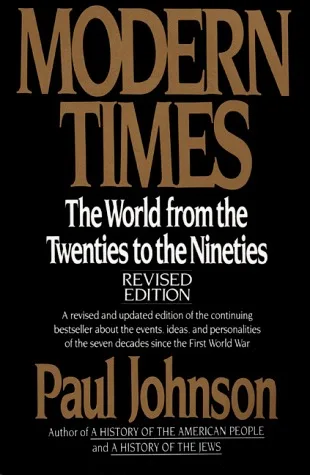
Paul Johnson interprets the twentieth century as an era defined by the vacuum of moral authority left by the decline of traditional religious values. He frames the history of this period around the rise of "relativism," arguing that Albert Einstein’s physics was misinterpreted to justify social and moral permissiveness. The narrative tracks the emergence of the "professional politician" and the expansion of the state, examining how ideologies like Marxism and National Socialism filled the void. Johnson focuses on the catastrophic human cost of state-driven engineering under leaders such as Lenin, Stalin, Mao, and Hitler.
This book serves readers who prefer a conservative, individualistic lens on history and want a direct challenge to secular, collectivist interpretations of modern events. It appeals to those interested in the nexus of geopolitical power and political philosophy. The reader gains a skeptical framework for viewing government expansion and a detailed timeline of how centralized authority replaced nineteenth-century liberalism. By the end, the reader possesses a narrative that correlates the rise of the total state with the darkest humanitarian disasters of the age.
- Published
- 1983
- Language
- EN
More by Paul Johnson
See all →




Readers also enjoyed