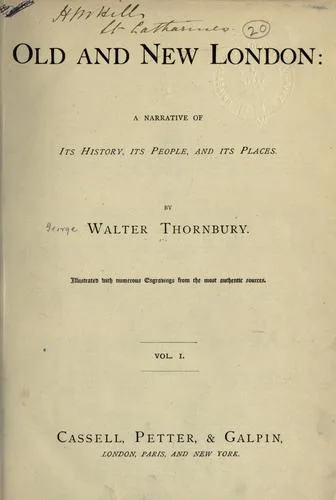
Walter Thornbury’s "Old and New London" provides an exhaustive topographical and social record of England's capital, tracing its growth from an ancient walled settlement to a sprawling nineteenth-century metropolis. The text documents the architectural evolution of city streets, the shifting boundaries of parishes, and the rise of civic institutions like the Guildhall and the Tower of London. Thornbury examines the distinct identities of areas such as Westminster and the City, detailing the construction of bridges, the history of noble estates, and the daily habits of the diverse population that inhabited these districts over several centuries.
This work serves historians, genealogists, and urban planners who require a granular understanding of London’s physical and cultural development. Readers gain a technical perspective on how street layouts and public buildings reflect the changing economic needs of the British Empire. By studying these volumes, an investigator identifies the locations of vanished landmarks and understands the administrative transformations that shaped modern municipal governance. The book offers a factual foundation for anyone analyzing the specific intersections of geography and history within an urban environment.
Insights from Old and New London
“The very stones of the streets are records of the past.”
Living in London means walking over layers of dead people. Every fancy shop window sits right on top of a thousand years of bones.
St. Paul’s Cathedral feels permanent to us. The book shows how it rose from ashes while everyone was still mourning the old city.
“The great highway of English thought.”
Fleet Street used to be pure chaos. It was full of ink stains and loud printing presses instead of just quiet offices.
Tyburn was a place of execution but also a weirdly festive social event. People treated a hanging like a trip to the theater.
- Published
- 1800
- Publisher
- General Books LLC
- ISBN
- 9781151848987
- Language
- EN
Readers also enjoyed