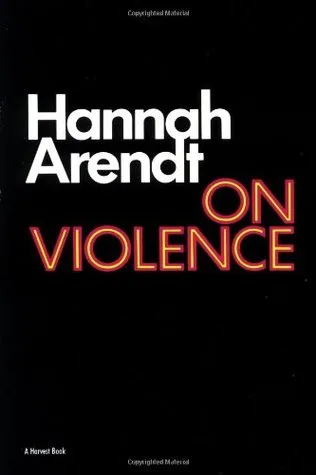
Hannah Arendt challenges the common assumption that violence represents the ultimate expression of power. She argues that these two concepts are opposites: power emerges from collective action and political consensus, while violence serves as a mechanical substitute used when power is lost. The text analyzes the escalation of student protests and New Left movements in the late sixties, distinguishing between legitimate authority and mere force. Arendt details how bureaucratic rule leads to a "rule by Nobody," creating a vacuum that often triggers violent outbursts as a desperate attempt to regain political agency.
This book serves students of political theory and sociology who want to understand the mechanics of civil unrest and institutional control. Readers gain a framework for identifying the differences between strength, force, and authority in modern governance. It provides a lens for evaluating why governments resort to coercion and how public assembly creates genuine political influence. The text offers a clear-eyed assessment of the limitations of armed struggle in achieving lasting social change, leaving the reader with a practical vocabulary for analyzing state action.
- Published
- 1970
- Language
- EN
More by Hannah Arendt
See all →


Readers also enjoyed