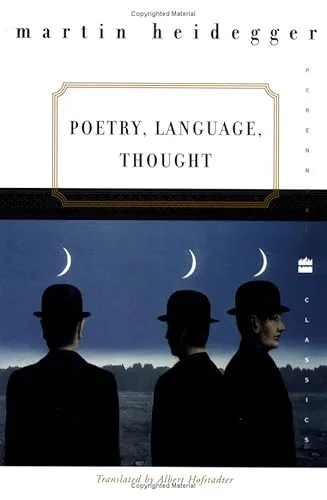
In this collection of essays, Martin Heidegger examines the ontological function of art, specifically how poetry and architecture disclose the nature of being. He argues that language is not merely a communication tool but the "house of being" where truth occurs. The text introduces the concept of the "Fourfold"—earth, sky, divinities, and mortals—as a framework for understanding how human beings inhabit the world. Through close readings of Friedrich Hölderlin’s verse and an analysis of how a bridge or a jug gathers a physical site, he defines "dwelling" as a way of existing that preserves the integrity of things rather than treating them as mere resources.
Philosophers and students of aesthetics read this work to understand the shift from traditional metaphysics toward an existential interpretation of creativity. Readers walk away with a specific vocabulary for discussing how buildings and poems establish a cultural "clearance" for truth to manifest. The book appeals to those interested in phenomenology and the critique of modern technology. It provides a method for analyzing how physical spaces and linguistic structures shape human identity and our relationship to the environment.
- Published
- 1971
- Language
- EN
Quotes by Martin Heidegger
More →He who thinks great thoughts, often makes great errors.