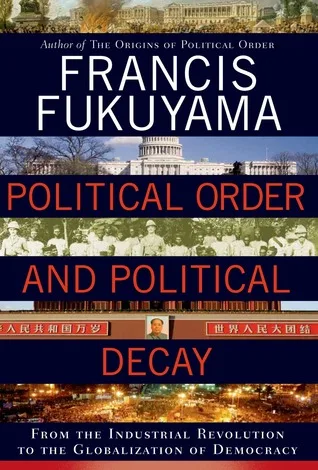
Political Order and Political Decay: From the Industrial Revolution to the Globalization of Democracy
Francis Fukuyama examines the historical development of the modern state, focusing on how institutions achieve stability or succumb to internal rot. He analyzes three critical components of political order: a strong centralized state, the rule of law, and democratic accountability. Using examples like the Prussian civil service, the American spoils system, and the rise of the middle class in emerging economies, the text argues that political decay occurs when institutions fail to adapt to changing social conditions. A major portion of the work evaluates why the United States suffers from institutional capture by special interest groups, leading to a paralyzed "vetocracy" that prevents effective governance.
This volume serves students of geopolitics and professional policy analysts who require a structural understanding of how nations rise and stall. Readers gain a framework for comparing the institutional health of different regimes, moving beyond simple definitions of democracy. The text provides a lens for identifying the warning signs of administrative decline, specifically how clientelism and judicial overreach weaken the state's capacity to deliver public services. Those who study this work walk away with a methodology for assessing whether a government can still function under the pressure of global economic competition.
- Published
- 2014
- Language
- EN
More by Francis Fukuyama
See all →



Readers also enjoyed