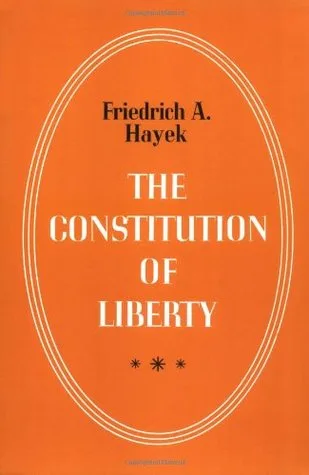
In this 1960 political treatise, Friedrich A. Hayek defines liberty as the absence of coercion by others. He builds a framework for a free society based on the rule of law, private property, and the spontaneous order of the market. Hayek argues that because human knowledge is inherently fragmented and decentralized, centralized planning inevitably fails. He details specific policy positions on progressive taxation, labor unions, and the burgeoning welfare state, contending that state-mandated redistributive justice undermines the legal neutrality necessary for individual agency.
This text serves economists, political theorists, and business strategists seeking a rigorous defense of classical liberalism. Readers study Hayek to understand the philosophical foundations of limited government and the mechanisms by which market competition coordinates diverse interests. The book provides a technical vocabulary for analyzing how bureaucratic expansion threatens legal equality. Those who finish the work obtain a systemic worldview on how institutional constraints and judicial consistency protect long-term economic prosperity from short-term political intervention.
- Published
- 1960
- Language
- EN