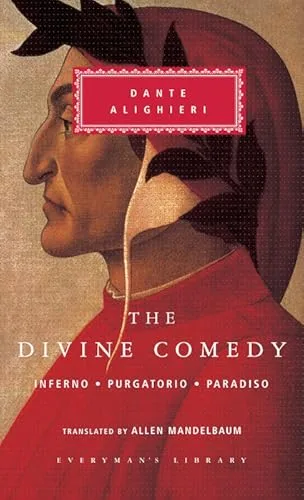
Dante Alighieri narrates his own passage through the three realms of the afterlife, beginning in a dark forest where the Roman poet Virgil meets him. Together, they descend into the Inferno, a funnel-shaped pit containing nine circles of specific physical punishments for transgressions like fraud, treachery, and violence. They then ascend the mountain of Purgatorio, where penitent souls undergo cleansing rituals to address the seven deadly sins. Finally, guided by Beatrice, Dante enters the celestial spheres of Paradiso, concluding with a vision of the divine hierarchy and the theological order governing the universe.
Students of medieval history and classical literature read this work to understand the synthesis of Aristotelian philosophy and Catholic doctrine. The text provides a map of fourteenth-century political grievances and the transition from Latin to vernacular Italian. Readers finish the poem with a precise vocabulary for moral categorization and an understanding of how historical figures were integrated into a theological framework. It functions as a study of structural symmetry and the application of strict logic to the concept of eternal justice.
Deep, contemplative and open-ended; a demanding read.
Best for readers like The Wisdom Collector. Which reader are you?
- Published
- 1320
- Language
- EN
Quotes by Dante Alighieri
More →There is no greater sorrow than to recall happiness in times of misery.
The Divine Comedy
In the middle of the journey of our life, I found myself in a dark wood, for the straight way was lost.
The Divine Comedy