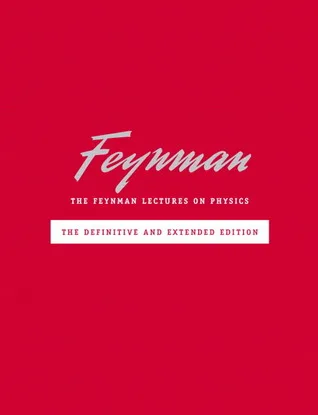
Derived from a series of introductory lectures at Caltech, this three-volume set provides a comprehensive overview of fundamental physics and its mathematical foundations. Feynman moves from the basic laws of classical mechanics and the conservation of energy into more complex domains like electromagnetism, optics, and statistical mechanics. He organizes physical laws through the lens of atomic theory and symmetry, eventually moving into the mathematics of wave functions and the conceptual paradoxes of quantum mechanics. Rather than relying on rote memorization, the text explains the physical reasoning behind Maxwell’s equations, thermodynamic cycles, and the behavior of subatomic particles.
Science students and practicing engineers read these volumes to deepen their conceptual understanding of how physical laws interlock. The text serves as a reference for those who want to move beyond procedural problem-solving into the actual logic of physical systems. Readers walk away with a functional framework for visualizing motion, forces, and fields, along with the ability to apply rigorous mathematical tools to describe the natural world. It is suited for those who already possess a background in calculus and seek a unified view of the discipline.
Deep and outward-looking; a demanding read.
Best for readers like The Systems Thinker. Which reader are you?
- Published
- 1964
- Language
- EN
More by Richard P. Feynman
See all →