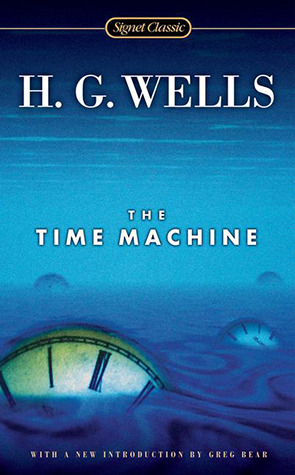
In 1895 London, an unnamed Victorian inventor constructs a crystalline vehicle capable of traversing the fourth dimension. He travels to the year 802,701, where he discovers the human race has diverged into two distinct species. The Eloi are small, frail, and child-like vegetarians living in communal luxury, while the Morlocks are predatory, subterranean laborers who maintain the machinery of the world. The Time Machine documents his struggle to recover his stolen craft and his realization that these species represent the final, decadent outcome of human class struggle.
This novella serves readers interested in the origins of scientific romance and the physical consequences of social stratification. It attracts those who value materialist speculation over fantasy, as the narrative explains how biological evolution reacts to industrial conditions. Readers walk away with a stark vision of entropy, witnessing a future where humanity is not refined but diminished, eventually facing a dying planet where the sun has ceased to provide heat and civilization has vanished entirely.
Outward-looking; a moderate read.
Best for readers like The Systems Thinker. Which reader are you?
Insights from The Time Machine
“So, in the end, above ground you must have the Haves, and below ground the Have-nots.”
Humanity eventually splits into two separate species based on class. One lives in the light while the other hunts in the dark.
“Strength is the outcome of need. Security sets a premium on feebleness.”
Progress can actually make us weak. Without struggle or danger, our minds and bodies just start to wither away.
“There is no intelligence where there is no change and no need of change.”
Intelligence depends on having problems to solve. A perfect world with no conflict leads to a quiet sort of idiocy.
“I saw huge buildings rise up faint and fair, and pass like dreams.”
Every great civilization eventually hits a wall. Even the most beautiful buildings end up as ruins covered in weeds.
- Published
- 1895
- Language
- EN