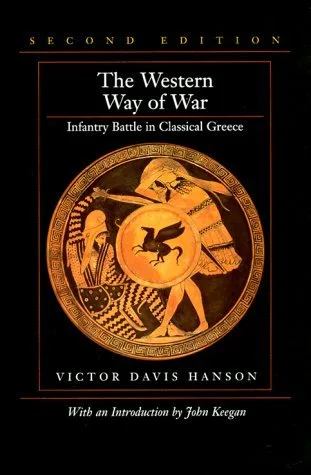
Victor Davis Hanson rejects the traditional focus on strategic maneuvers and elite commanders to reconstruct the physical sensations of the hoplite phalanx. He argues that Greek warfare was defined by a specific ritual of decisive, face-to-face collision between heavy infantrymen who were also agrarian landowners. The book details the weight of seventy-pound bronze panoplies, the restricted vision inside Corinthian helmets, and the visceral trauma of the "othismos," or the collective shove. This framework presents Western military tradition as a preference for sudden, lethal shocks over attrition or indirect skirmishing.
Students of military history and classical studies read this for its focus on the common soldier’s perspective. It provides a technical understanding of how ancient bronze armor functioned under duress and how social status tied directly to battlefield positions. Readers walk away with a realistic sense of the noises, odors, and collective psychological pressure inherent in spear-and-shield combat. The text explains how the political autonomy of the Greek city-state shaped a specific, localized method of slaughter designed to conclude disputes in a single afternoon.
- Published
- 1989
- Language
- EN
More by Victor Davis Hanson
See all →

Readers also enjoyed