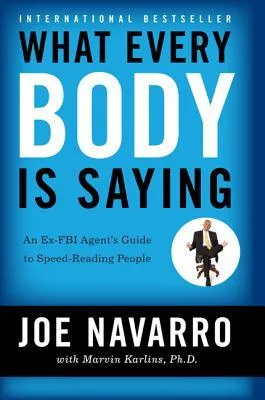
What Every Body is Saying: An Ex-FBI Agent's Guide to Speed-Reading People
Joe Navarro utilizes his experience as an FBI counterintelligence officer to explain how the limbic system dictates involuntary physical responses. The text focuses on nonverbal communication, specifically how high-stress situations trigger pacifying behaviors like neck touching or leg rubbing. Navarro introduces the concept of structural observation, starting from the feet and legs—which he identifies as the most honest parts of the body—and moving upward to the torso and face. He details specific cues for hidden discomfort, such as eyelid fluttering, lip compression, and territorial displays.
Legal professionals, mediators, and corporate negotiators read this to improve their ability to detect concealed tension or lack of confidence during interviews. Readers learn to distinguish between genuine comfort and feigned composure by watching for micro-gestures and spatial shifts. The book provides a framework for analyzing social interactions in real time, allowing people to adjust their own behavior to build rapport or recognize when a counterpart is withholding information through subtle shifts in posture or hand placement.
Practical, growth-minded and clear-cut; an easy read.
Best for readers like The Growth Strategist. Which reader are you?
Insights from What Every Body is Saying: An Ex-FBI Agent's Guide to Speed-Reading People
“Our feet and legs are the most honest parts of our body.”
Your feet usually point where you really want to go. If someone turns their torso toward you but keeps their feet aimed at the door, they want to leave.
“Neck touching and/or stroking is one of the most significant and frequent pacifying behaviors.”
Touching your neck or playing with a necklace is a way to self-soothe. It helps lower your heart rate when you feel stressed or threatened.
“Our eyes have evolved to block out or shield us from things we don't like.”
Squinting isn't always about bad eyesight. We instinctively block out light or images we don't like to protect ourselves from bad news.
“High confidence is reflected in the display of thumbs.”
Thumbs sticking out of pockets show a lot of confidence. Tucking them away usually means someone feels insecure or low in status.
- Published
- 2008
- Publisher
- Collins
- ISBN
- 9780061438295
- Language
- EN