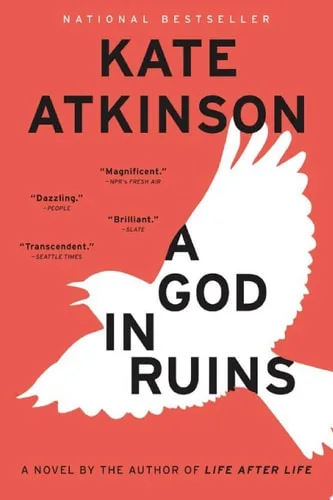
A God in Ruins follows the life of Teddy Todd, an RAF bomber pilot who survives the heavy casualty rates of World War II against his own expectations. The narrative moves non-linearly across the twentieth century, detailing Teddy’s missions over Germany and his subsequent quiet life as a husband, father, and grandfather. The story documents his difficult relationship with his daughter Viola, his transition into a suburban existence, and the physical decline of his later years. It focuses on the specific technical demands of aviation and the logistical reality of living through a century defined by the aftermath of total war.
Readers of historical fiction and multi-generational sagas choose this book to see how a single life is shaped by specific historical trauma and the passage of time. The text provides a detailed perspective on the psychological burden of survival and the disconnect between an individual's wartime heroism and their mundane domestic reality. A reader walks away with a concrete understanding of the physical risks faced by bomber crews and a stark portrait of how the promises of the post-war era translated into the complexities of modern British family life.
Deep, inward-looking, contemplative, open-ended and thought-provoking; a demanding read.
Best for readers like The Wisdom Collector. Which reader are you?
Insights from A God in Ruins
“It was better to be a dead god than a live one.”
Teddy goes through the war expecting to die every night. Then he has to figure out how to live for fifty years. It feels like he never quite landed his plane.
Viola is such a difficult daughter. You see her hurting Teddy and it breaks your heart. She just cannot see the gentle man right in front of her.
“The war was a long period of waiting, punctuated by moments of extreme fear.”
The scenes in the Halifax bomber are so cramped and cold. You realize these boys were just terrified children in heavy coats. They were doing the impossible before they could even vote.
“Nature was the only thing that mattered.”
Teddy finds so much peace in his garden later in life. After seeing cities burn, pulling weeds seems like the only thing that makes sense. It is his way of being quiet.
- Published
- 2015
- Publisher
- Hachette
- ISBN
- 9780316341554
- Language
- EN