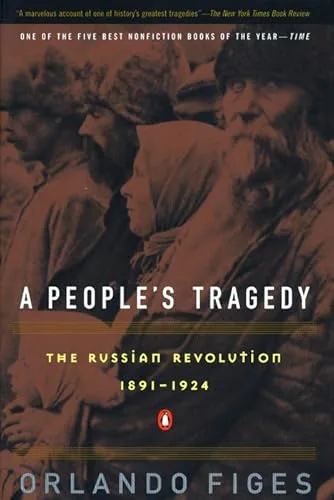
Orlando Figes presents the Russian Revolution as a continuous social and political collapse beginning with the 1891 famine and ending with Lenin’s death. He argues that the uprising was not a simple coup but a vast, chaotic tragedy driven by the aspirations and violent resentments of the peasantry. Figes focuses on how the autocratic failures of Nicholas II clashed with the radical ideologies of the Bolsheviks, ultimately replacing one form of state-driven terror with another. He uses personal diaries and private correspondence to document the specific experiences of individuals, from princes to provincial workers, to illustrate how private lives were destroyed by the totalizing force of the revolutionary machine.
This book is intended for students of Soviet history and readers interested in the mechanics of regime change and state violence. It appeals to those who want a comprehensive narrative that links high-level political decisions to the visceral reality of life on the ground. Readers finish the text with an understanding of how mass participation in a popular revolt can inadvertently lead to a totalitarian dictatorship. It provides a detailed chronological framework for analyzing how deep-seated social grievances were harnessed by a militant minority to reshape an entire civilization through civil war and systemic repression.
- Published
- 1996
- Language
- EN
More by Orlando Figes
See all →
Readers also enjoyed