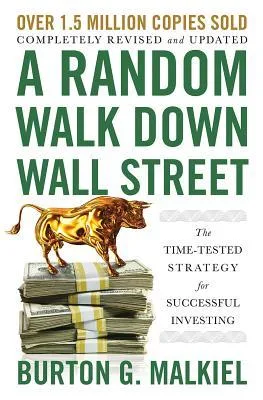
A Random Walk Down Wall Street: The Time-Tested Strategy for Successful Investing
Burton G. Malkiel argues that stock market prices follow a random walk, meaning past performance cannot predict future movements. He examines the efficient market hypothesis, suggesting that individual stock picking and technical analysis are generally ineffective because current prices already incorporate all available information. The text breaks down the differences between fundamental analysis, which focuses on intrinsic value, and the "castle-in-the-air" theory of behavioral patterns. Malkiel introduces the benefits of broad-based index funds and tax-loss harvesting as superior alternatives to active trading or chasing speculative bubbles.
Investors read this book to understand why passive management often outperforms active portfolio managers over long periods. It is written for individuals seeking a practical framework for asset allocation based on age and risk tolerance. Readers walk away with a specific plan for buying low-cost index funds and rebalancing their holdings. The book provides the data needed to ignore short-term market noise and high-commission brokerage advice, replacing complex trading theories with a straightforward mathematical approach to personal wealth accumulation.
Outward-looking, growth-minded and clear-cut; a moderate read.
Best for readers like The Practical Optimizer. Which reader are you?
- Published
- 1973
- Language
- EN
More by Burton G. Malkiel
See all →
Books like A Random Walk Down Wall Street: The Time-Tested Strategy for Successful Investing
See all 12 →