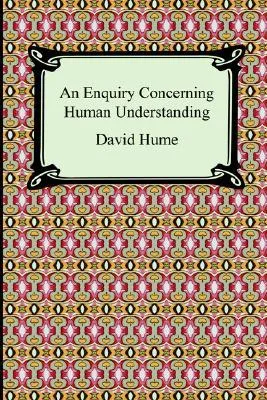
David Hume rejects the notion of innate ideas, arguing instead that all human thought derives from sensory impressions. He distinguishes between relations of ideas, which are logically certain, and matters of fact, which rely on the principle of cause and effect. Hume posits that we cannot rationally prove a necessary connection between a cause and its outcome; rather, we anticipate regularities through custom and habit. He also introduces a skeptical framework regarding miracles, asserting that the evidence of uniform laws of nature outweighs any individual testimony of supernatural events.
This text serves students of epistemology and cognitive science who seek to understand the origins of modern empiricism. Readers gain a framework for distinguishing between demonstrative reasoning and probable reasoning based on experience. By studying Hume’s analysis of induction, the reader learns to question the logical foundations of everyday assumptions and scientific predictions. The work provides a basis for evaluating the limits of human reason and the role of psychological association in forming beliefs about the external world.
- Published
- 1748
- Language
- EN