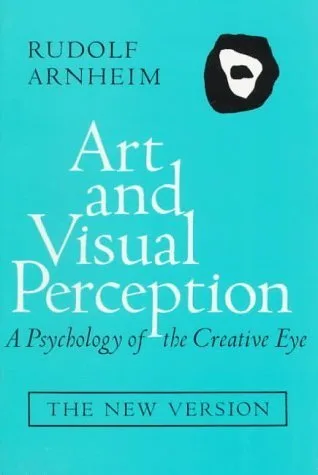
Art and Visual Perception: A Psychology of the Creative Eye
Rudolf Arnheim applies Gestalt psychology to the visual arts to explain how the human eye organizes information into meaning. He breaks down the viewing process through specific categories, including balance, shape, form, growth, space, light, color, and movement. The text argues that perception is not a passive recording of stimuli but an active, intellectual act of organizing patterns. By examining how forces like gravity and tension operate within a frame, Arnheim demonstrates why certain compositions feel stable or dynamic and how viewers extract expression from sensory data.
Artists, designers, and art historians study this book to gain a technical vocabulary for visual intuition. It provides a structural framework for understanding why specific arrangements of lines and colors produce predictable psychological effects in an audience. Readers walk away with the ability to analyze images as systems of forces rather than just a collection of objects. This helps creators intentionally manipulate visual weight and spatial depth to achieve clarity and impact in their own work.
- Published
- 1954
- Language
- EN