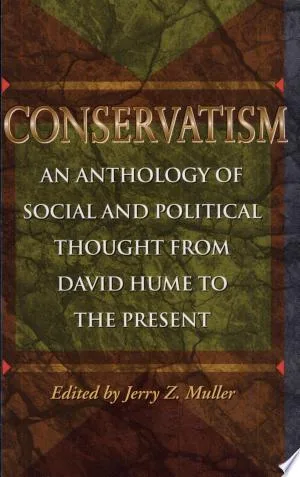
Jerry Z. Muller presents conservatism as a modern social theory born from the Enlightenment rather than a mere defense of ancient traditions. He argues that conservative thought emerged as a reaction to radical rationalism, emphasizing the utility of established institutions like religion, property, and the family. Through an anthology of key texts spanning from David Hume and Edmund Burke to late twentieth-century thinkers, Muller identifies recurring frameworks such as the fallibility of human reason and the importance of unintended consequences. The collection distinguishes utilitarian conservatism from religious orthodoxy, highlighting how thinkers justify existing hierarchies based on their practical role in maintaining social stability.
Scholars and students of political theory read this volume to understand the historical continuity of right-wing intellectual thought across different centuries and nations. The book provides readers with a taxonomy of conservative arguments, moving beyond partisan slogans to analyze the core logic of institutional preservation. A reader walks away with a clear grasp of how conservative intellectuals evaluate social change and why they prioritize historical experience over abstract blueprints for reform. It serves as a technical resource for those tracking the evolution of classical liberal and traditionalist ideas within Western politics.
Deep and outward-looking; a demanding read.
Best for readers like The Systems Thinker. Which reader are you?
- Published
- 1997
- Publisher
- Princeton University Press
- ISBN
- 9780691037110
- Language
- EN