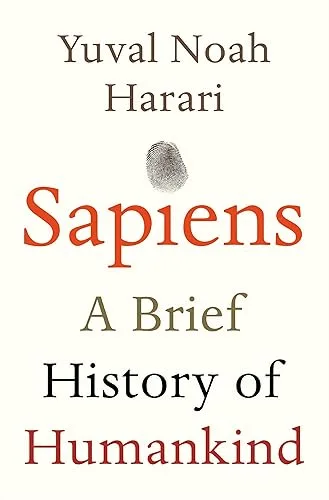
Yuval Noah Harari tracks the biological and social evolution of Homo sapiens from our origins as a minor African primate to our current dominance over the biosphere. He identifies the Cognitive Revolution as the catalyst for our success, arguing that our unique ability to believe in shared myths—such as money, laws, and gods—allowed thousands of strangers to cooperate effectively. The narrative traces how the Agricultural Revolution shifted humans from foragers into settlers tied to domestic crops, followed by the Scientific Revolution which dismantled traditional ignorance in favor of empirical discovery and global capitalism.
Readers interested in the intersections of anthropology and macro-history will find a framework for understanding how belief systems dictate modern world structures. The book appeals to those looking to analyze social institutions through an evolutionary lens rather than a political one. By the final chapter, the reader gains a perspective on how artificial intelligence and genetic engineering now threaten to end the history of the species as we currently define it. They walk away with a functional theory on why human structures remain fragile despite our technological mastery.
Insights from Sapiens: A Brief History of Humankind
“There are no gods in the universe, no nations, no money and no human rights outside the common imagination of human beings.”
Humans only rule because we believe in things that don't exist physically. Currency and laws only work because we all agree to pretend they are real.
“We did not domesticate wheat. It domesticated us.”
Wheat actually domesticated us instead of the other way around. It forced us to stay in one place and work back-breaking hours in the sun.
Hunter-gatherers enjoyed more leisure and a better diet than early farmers did. Settling down led to more disease and much more stress.
“Our internal biochemical system is programmed to keep emotional levels relatively constant.”
Happiness mostly depends on biological systems and expectations rather than external success. Our ancestors were likely just as content as we are today.
- Published
- 2011
- Publisher
- Random House
- ISBN
- 9781448190690
- Language
- EN
More by Yuval Noah Harari
See all →




Readers also enjoyed