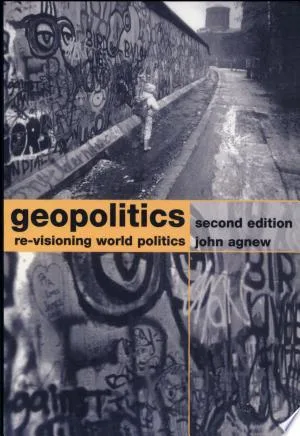
John Agnew analyzes how the spatial distribution of power shifted from the rise of modern states in the sixteenth century to the post-Cold War era. He challenges the traditional view of geopolitics as a fixed struggle for territory by documenting three distinct historical epochs: civilizational, naturalized, and ideological geopolitics. The text introduces the concept of the territorial trap, arguing that political analysis often fails because it assumes state borders are the only containers of economic and social life. Agnew examines how global networks and international organizations now compete with the sovereignty of individual nations.
Political geographers, international relations scholars, and graduate students read this book to understand the intellectual history of spatial strategy. Readers gain a framework for analyzing how maps and geographic labels are used to justify foreign policy and military intervention. The text provides the tools to deconstruct modern global issues, moving beyond simple state-on-state rivalry to account for transnational identity and global economic integration. By the end, the reader can distinguish between fixed territorial power and the fluid influence of globalized networks.
Deep and outward-looking; a demanding read.
Best for readers like The Systems Thinker. Which reader are you?
- Published
- 2003
- Publisher
- Psychology Press
- ISBN
- 9780415310079
- Language
- EN