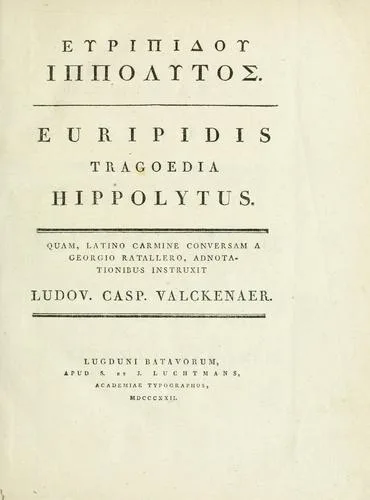
This drama depicts the lethal consequences of a young prince’s absolute devotion to Artemis and his rejection of Aphrodite. Outraged by Hippolytus’s insistence on chastity, Aphrodite strikes his stepmother, Phaedra, with an uncontrollable passion for him. When Phaedra’s nurse reveals this secret, the prince reacts with vitriol, leading Phaedra to take her own life and leave behind a false accusation of rape. King Theseus, believing the lie, invokes a curse from Poseidon that results in a sea monster destroying his son’s chariot.
Students of classical philology and ancient ethics read this work to examine the tension between human impulse and divine caprice. The text provides a rigorous look at the concept of sophrosyne, or moderation, and how extreme virtue can lead to ruin just as easily as vice. Readers walk away with an understanding of how Greek tragedy uses the conflict between competing deities to map the internal wreckage of a family destroyed by silence and misplaced honor.
Deep, inward-looking, contemplative, open-ended and thought-provoking; a moderate read.
Best for readers like The Wisdom Collector. Which reader are you?
- Published
- 1756
- Language
- EN