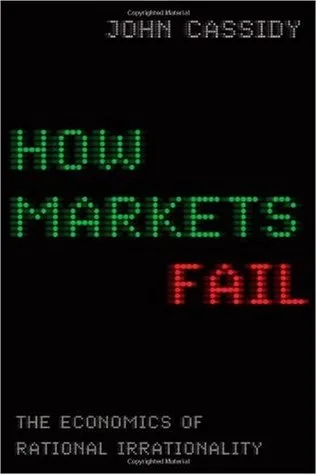
John Cassidy examines the rise and fall of Utopian Economics, the theory that competitive markets are inherently self-correcting and efficient. He traces the intellectual lineage of this ideology from Adam Smith to the Chicago School, contrasting it with Reality Based Economics. The text analyzes market failures through concepts like information asymmetry, cognitive biases, and the prisoner’s dilemma. Cassidy specifically applies these frameworks to the 2008 financial crisis, detailing how rational individual actions in the banking and housing sectors aggregated into a collective systemic collapse that free-market models failed to predict.
This book is intended for students of political economy and finance professionals seeking to understand why deregulated systems foster instability. Readers learn the technical distinctions between individual rationality and market efficiency. The book provides a historical perspective on how economic policy shifted toward laissez-faire practices and offers a toolkit for identifying asset bubbles. By the end, the reader understands the structural necessity of government oversight and the specific mathematical flaws inherent in purely theoretical market models.
- Published
- 2009
- Language
- EN