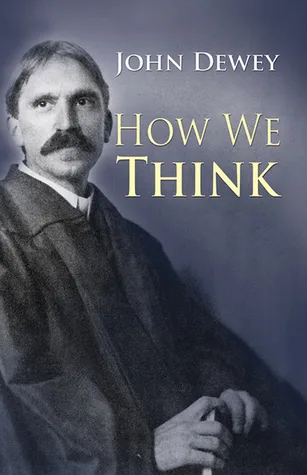
John Dewey defines reflective thought as the active, persistent, and careful consideration of any belief based on the grounds that support it. He outlines a five-step psychological process for problem-solving: encountering a felt difficulty, defining its location, suggesting possible solutions, reasoning through the implications of those ideas, and testing the hypothesis through action. Dewey argues against rote memorization, proposing that the scientific method serves as the ideal model for human cognition. He contrasts reflective thinking with impulsive behavior and idle stream-of-consciousness, emphasizing that logical training requires cultivating specific mental attitudes like open-mindedness and whole-heartedness.
Teachers and curriculum designers read this text to understand how to structure lessons around inquiry rather than the passive transmission of facts. The book provides a framework for turning school classrooms into environments for experimentation and critical observation. Readers walk away with techniques for balancing spontaneous curiosity with systematic discipline. They gain a methodology for identifying obstacles in a student's logical development and a set of principles for fostering independent judgment through the practical application of ideas in real-world contexts.
- Published
- 1910
- Language
- EN