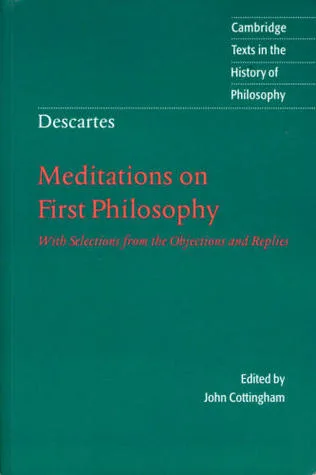
Descartes begins by applying radical doubt to every piece of sensory information he has ever received, systematically stripping away his belief in the physical world and his own body. He argues that even if a deceptive demon were to manipulate his perceptions, the act of doubting itself proves his existence as a thinking thing, established through the axiom of the cogito. From this foundation, he uses ontological proofs to argue for the existence of a non-deceiving God and proposes a strict dualism between the immaterial mind and the mechanical physical world.
Students of philosophy and cognitive science consult this text to understand the historical origins of the mind-body problem. Readers analyze these arguments to find a rational basis for human knowledge that does not rely on empirical observation alone. By the end, the reader understands the logic behind Cartesian dualism and the method of using skeptical inquiry to identify truths that are beyond logical dispute. This work provides a framework for distinguishing between subjective experience and objective reality.
- Published
- 1641
- Language
- EN