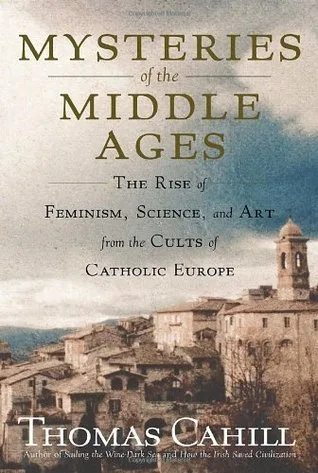
Mysteries of the Middle Ages: The Rise of Feminism, Science and Art from the Cults of Catholic Europe
Thomas Cahill argues that the High Middle Ages served as the actual incubator for modern Western individualism. He tracks the shift from rigid feudal structures to a more expressive culture through the rise of urban universities and the veneration of the Virgin Mary. The narrative centers on pivotal figures like Eleanor of Aquitaine, who introduced courtly love, and Hildegard of Bingen, who asserted intellectual independence within the church. By examining the scholastic logic of Thomas Aquinas and the naturalism of Giotto, Cahill demonstrates how medieval thinkers synthesized Greek philosophy with Christian mysticism to create the foundations of empirical science and humanistic art.
This history attracts readers interested in how religious institutions paradoxically fostered secular progress. People read it to understand the transition from the communal mindset of the Dark Ages to the ego-driven creativity of the Renaissance. The reader walks away with a clear grasp of how feminine influence and dialectical reasoning dismantled the monolithic authority of the early medieval period. It provides a specific historical framework for seeing the Middle Ages not as a stagnant era of ignorance, but as a period of rapid social and intellectual evolution.
- Language
- EN