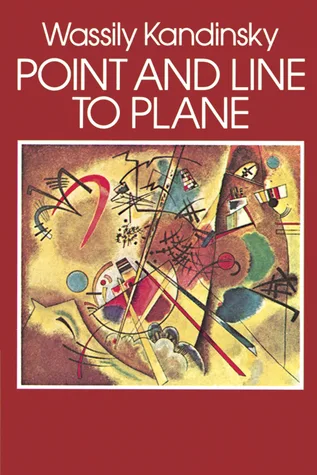
Published during his tenure at the Bauhaus, Kandinsky’s treatise establishes a formal grammar for abstract composition. He deconstructs visual art into its most basic geometric constituents: the point, the line, and the plane. Kandinsky argues that the point represents the ultimate silence, which, when set in motion, creates a line characterized by specific tensions and directions. He categorizes lines by their capacity to express temperature and pressure, eventually explaining how these elements interact with the basic "primary plane" of the canvas to create rhythmic, spatial structures independent of representational subjects.
This technical manual serves artists, designers, and art theorists seeking a scientific logic for non-objective painting. Readers use this framework to move beyond intuitive creation toward a systematic understanding of weights, balances, and graphic forces. By studying these geometric relationships, the reader acquires a precise vocabulary for analyzing the psychological impact of shapes. They walk away with a methodology for organizing a flat surface into a coherent psychological environment where every mark serves a functional purpose in the overall composition.
- Published
- 1926
- Language
- EN