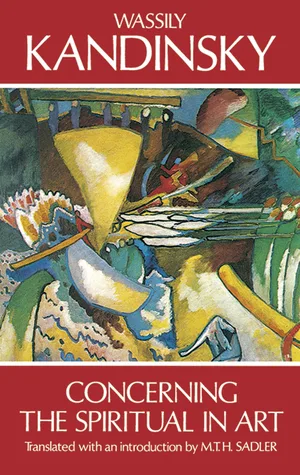
Wassily Kandinsky identifies painting as a psychological tool rather than a method for reproducing physical reality. He establishes a framework for abstraction based on "internal necessity," arguing that artists must prioritize their inner emotional lives over external mimesis. The text categorizes colors and shapes by their spiritual vibrations, likening the visual arts to music. Kandinsky describes a metaphorical triangle representing the spiritual progress of humanity, where the artist occupies the peak, pulling the masses upward through the creation of non-objective forms.
Artists and historians read this book to understand the formal transition from representation to pure abstraction. It appeals to those seeking a technical vocabulary to describe how blue creates a sense of withdrawal or how a circle acts as a stable focal point. Readers learn to view the canvas as a site for communicating inner states without relying on recognizable objects. The text provides a theoretical foundation for analyzing art as a sequence of rhythmic, color-driven movements designed to affect the viewer’s soul directly.
Deep, inward-looking, contemplative and open-ended; a demanding read.
Best for readers like The Wisdom Collector. Which reader are you?
- Published
- 1912
- Language
- EN