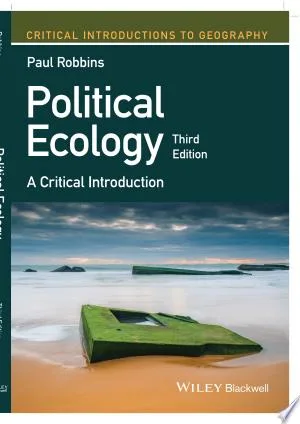
Paul Robbins examines the friction between ecological systems and human power structures, moving beyond simple explanations of scarcity or overpopulation. He framework centers on critical theory to analyze how environmental outcomes result from political processes, economic pressures, and historical colonial legacies. The text breaks the field into core pillars, including the degradation and marginalization thesis, environmental conflict, and the social construction of nature. By focusing on site-specific examples from Latin America and Asia, the author demonstrates how global market demands influence land-use decisions and resource distribution in local communities.
This book serves undergraduate students and researchers in geography, international development, and environmental studies. Readers gain a technical vocabulary for questioning traditional conservation methods that ignore local politics. The text provides a clear map of how to apply political sociology to environmental management challenges. By the end, the audience understands how to identify the winners and losers in ecological crises, walking away with a toolkit for analyzing resource management through the lens of social justice and equity.
Deep and outward-looking; a moderate read.
Best for readers like The Systems Thinker. Which reader are you?
- Published
- 2019
- Publisher
- John Wiley & Sons
- ISBN
- 9781119167440
- Language
- EN