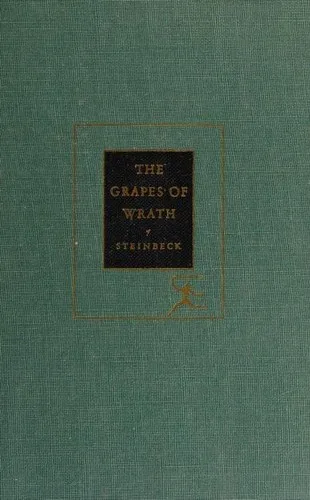
In 1930s America, a severe drought and aggressive agricultural mechanization force the Joad family off their Oklahoma farm. Tom Joad, recently paroled from McAlester prison, joins his relatives and an ex-preacher, Jim Casy, on a trek across Route 66 to California. They seek survival in a labor market flooded with displaced migrants. Upon arrival, they find low wages, hostile law enforcement, and makeshift Hoovervilles. The narrative details their struggle against corporate farming interests and the starvation that accompanies the collapse of small-scale land ownership.
This novel serves students of the Great Depression and readers interested in the tension between labor movements and industrial capitalism. It provides a granular look at the logistics of poverty and the endurance of family structures under extreme economic stress. Readers walk away with a specific understanding of how environmental disaster and banking policies uprooted a generation of workers. It documents the transition from individual independence to collective action in the face of systemic resource scarcity.
Insights from The Grapes of Wrath
“Man, he lives in jerks. Woman, it's all one flow.”
Ma Joad is the real engine of the family. She keeps everyone moving when the men start to fall apart.
“How can we live without our lives? How will we know it's us without our past?”
Seeing the Joads sell their life for eighteen dollars broke my heart. All those memories just turned into junk on the lawn.
“And the great owners, who must lose their land in an upheaval, the great owners with access to history, with eyes to read history and to know the great fact: when property accumulates in too few hands it is taken away.”
California wasn't the dream they thought it would be. It was just a place where hungry people were treated like criminals.
“She looked up and across the barn, and her lips came together and smiled mysteriously.”
Rose of Sharon giving her milk to a starving stranger might be the saddest thing I ever read. It shows that even when you have nothing, you can still give.
- Published
- 1939
- Publisher
- Penguin Books
- ISBN
- 9780140042399
- Language
- EN
Quotes by John Steinbeck
More →Power does not corrupt. Fear corrupts, perhaps the fear of a loss of power.
The Short Reign of Pippin IV

![उस रात के बाद [Us Raat Ke Baad]](https://kwbjoqloympvbpzbrfja.supabase.co/storage/v1/object/public/scan-images/catalog/53673b08-18d0-4f03-8e5f-04a98899e36f-full.webp)