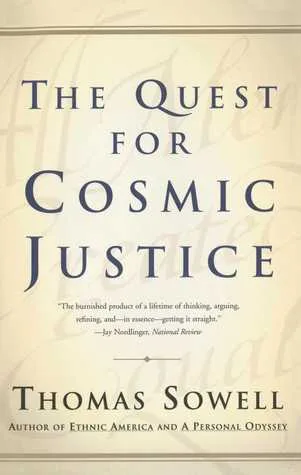
Thomas Sowell distinguishes between traditional justice, which emphasizes impartial rules and individual conduct, and cosmic justice, which seeks to equalize social and economic outcomes across groups. He argues that pursuing cosmic justice requires granting government officials the power to disregard established laws in order to rectify historical grievances or natural misfortunes. Through an analysis of judicial activism, income distribution, and meritocracy, Sowell demonstrates how third-party interventions often create unintended costs for the very people they intend to help while undermining the rule of law.
This book is for readers interested in political philosophy and the structural differences between egalitarianism and constitutionalism. It appeals to those seeking a logical critique of social engineering and redistributive policies. Readers walk away with a framework for evaluating the trade-offs between centralized visions of fairness and the practical realities of decentralized decision-making. The text provides a clear explanation of why absolute equality of result is incompatible with a free society governed by stable rules.
- Published
- 1999
- Language
- EN
More by Thomas Sowell
See all →

Readers also enjoyed