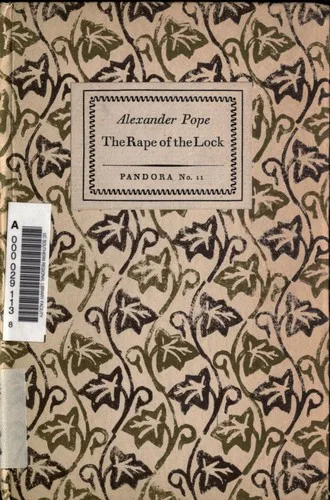
Belinda, a young woman of high fashion, begins her day with a complex grooming ritual assisted by the sylph Ariel, an ethereal protector. At a social gathering at Hampton Court Palace, the Baron, motivated by desire and competition, schemes to steal a lock of her hair. Using a pair of sewing scissors, he severs the curl despite the intervention of supernatural spirits. This event triggers an absurdly escalating conflict between the two aristocratic families. Pope uses the structure of a classical epic to describe the domestic skirmish, replacing great battles with card games and divine intervention with the movements of tiny, winged elemental beings.
This poem serves students of eighteenth-century satire and readers interested in the mechanics of the mock-heroic style. It offers a technical look at how formal neoclassical verse can be applied to trivial social disputes to expose vanity and gender dynamics in Georgian England. Readers gain an understanding of how Pope uses irony to criticize the preoccupation with physical appearance and social reputation. By the conclusion, the audience learns to recognize the juxtaposition of grandiose language with petty human grievances, witnessing how a private insult is mythologized into an astronomical event.
- Published
- 1714
- Language
- EN