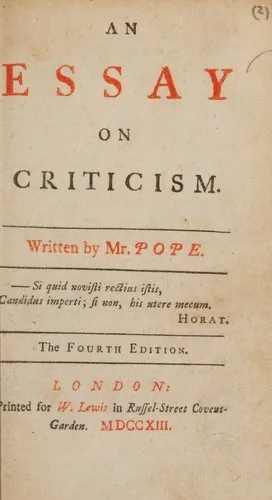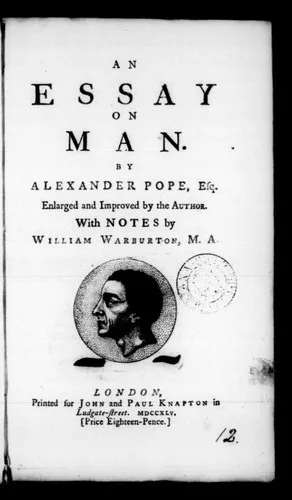
Alexander Pope’s philosophical poem defends the concept of a rational, divinely ordered universe where human limited perception prevents us from seeing the perfection of the whole. Organized into four epistles, the work addresses man’s relationship to the cosmos, to himself as an individual, to society, and to the pursuit of happiness. Pope argues that self-love and social benevolence operate under the same natural laws, asserting that humanity occupies a specific middle station between angels and beasts. He concludes that "Whatever is, is right," suggesting that apparent earthly chaos functions within a larger, coherent Great Chain of Being.
Readers of Enlightenment philosophy and neoclassical verse study this text to understand the transition from traditional theology to natural religion. It serves those interested in how eighteenth-century thinkers reconciled human suffering with the idea of a benevolent creator through logic rather than pure revelation. A reader gains a framework for viewing human flaws as necessary components of a balanced system. By finishing the poem, one acquires a vocabulary for discussing the tension between private desires and the public good, while observing how formal heroic couplets can structure complex ethical arguments.
- Published
- 1733
- Language
- EN