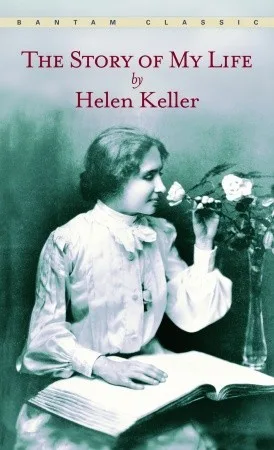
In this memoir, Helen Keller details her childhood following a severe illness that left her both blind and deaf at nineteen months old. She recounts the isolation of her early years in Alabama and the arrival of her teacher, Anne Sullivan, who bridged the gap between Keller and the world through the manual alphabet. The narrative focuses on the specific moment Keller realized that physical hand signs represented abstract concepts, specifically during the water pump incident where she connected the cool liquid with the letters spelled into her palm. She describes her subsequent education at the Wright-Humason School for the Deaf and the Horace Mann School, her struggle to master oral speech, and her eventual academic success at Radcliffe College.
This book serves readers interested in the history of disability education and the mechanics of language acquisition through tactile means. It appeals to those studying the intersection of physical impairment and societal integration at the turn of the twentieth century. Readers gain a technical understanding of how a person without sight or hearing learns to read Braille, use a typewriter, and communicate through finger spelling. The text provides a first-person perspective on the sensory adaptation required to navigate a world built for the sighted and hearing, offering specific insights into the persistence required for intellectual development under total sensory deprivation.
Inward-looking, contemplative and clear-cut; a moderate read.
Best for readers like The Empathetic Explorer. Which reader are you?
- Published
- 1902
- Language
- EN