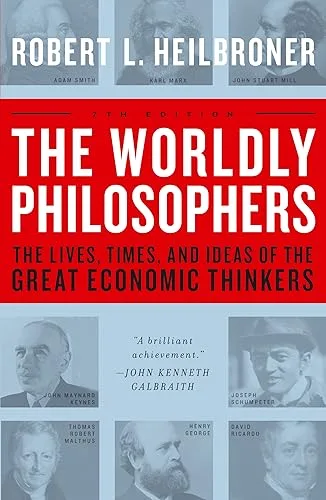
Robert L. Heilbroner traces the development of modern economic thought by profiling the lives and intellectual contributions of major figures such as Adam Smith, David Ricardo, Karl Marx, and John Maynard Keynes. The text explains how these thinkers interpreted the internal mechanics of capitalism, from the invisible hand and the division of labor to the labor theory of value and the causes of industrial depressions. It examines the transition from feudalism to market societies and analyzes the underlying logic that drives wealth accumulation, population growth, and cycles of boom and bust.
This book serves students of political economy and history who require a clear chronological map of how different fiscal and social frameworks emerged. Readers acquire a technical understanding of high-level economic theories without the burden of complex mathematical models. By observing the historical context behind specific doctrines, a reader gains the ability to identify the origins of current policy debates and understands how market systems change over time. It provides a foundation for analyzing how individual self-interest interacts with collective social stability.
Outward-looking; a moderate read.
Best for readers like The Evidence Seeker. Which reader are you?
- Published
- 1953
- Language
- EN