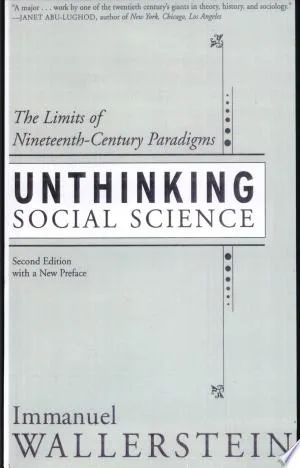
Immanuel Wallerstein argues that the analytical structures established in the nineteenth century now obstruct our ability to interpret the modern world-system. He targets the concept of developmentalism and the rigid division between history, economics, and sociology. Instead of viewing time and space as static backgrounds for human action, Wallerstein integrates geography and chronology into a singular framework of social transformation. He posits that the Enlightenment’s epistemological foundations, while once useful for challenging feudalism, have become intellectual barriers that prevent scholars from viewing global processes as unified, long-term historical shifts.
This work serves academics and researchers in political economy and sociology who seek to move beyond traditional state-centric analysis. Readers use this text to re-evaluate how they categorize global progress and to move past linear models of economic growth. By engaging with these critiques, a researcher gains a method for analyzing the world-system as a single entity rather than a collection of independent nations. The text provides a framework for replacing outdated paradigms with a more integrated approach to social and spatial change.
Deep and outward-looking; a demanding read.
Best for readers like The Systems Thinker. Which reader are you?
- Published
- 2001
- Publisher
- Temple University Press
- ISBN
- 9781566398992
- Language
- EN