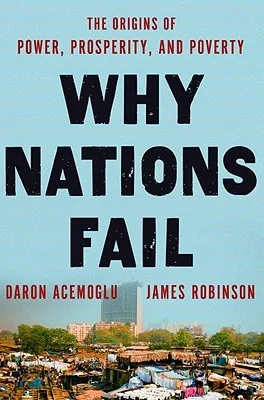
Why Nations Fail: The Origins of Power, Prosperity, and Poverty
Daron Acemoğlu and James Robinson argue that the fundamental driver of a country’s economic success is the nature of its political and economic institutions. They contrast "inclusive" institutions, which encourage innovation and protect private property through the rule of law, with "extractive" institutions designed to harvest wealth for a narrow elite. Using historical case studies like the division of the city of Nogales and the divergence between North and South Korea, the authors demonstrate how centralized, pluralistic power structures create incentives for long-term growth, whereas extractive systems inevitably lead to stagnation by stifling creative destruction.
This book serves students of political science and development economists who seek a structural explanation for global inequality. Readers gain a framework for analyzing why some regions remain trapped in poverty despite receiving foreign aid or possessing abundant natural resources. It provides a historical lens to evaluate how colonial legacies and early institutional choices dictate the current prosperity of modern states. By the end, the reader understands the link between political liberty and sustainable financial stability.
Deep and outward-looking; a moderate read.
Best for readers like The Systems Thinker. Which reader are you?
- Published
- 2012
- Language
- EN