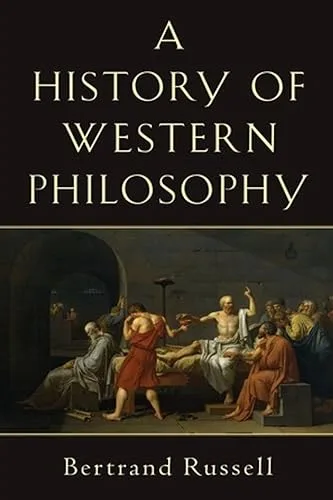
Bertrand Russell details the evolution of logical thought from the Pre-Socratics through the rise of logical analysis in the early twentieth century. He examines how social and political conditions shaped the theories of philosophers like Plato, Spinoza, and Kant. Instead of treating abstract ideas in isolation, Russell connects Hellenic mathematics to Catholic dogma and links Romanticism to the emergence of modern nationalism. He evaluates the transition from medieval Scholasticism and the synthesis of Thomas Aquinas to the empirical methods of Locke and Hume.
This volume serves students and researchers seeking a chronological map of European intellectual development. Readers use it to understand how specific philosophical schools influenced biological science and political governance. The text provides a clear sense of the causal links between religious tradition and secular reasoning. It is intended for those who want a surveyed view of logic and ethics without excessive technical jargon. A reader finishes the book with a framework for identifying the historical origins of contemporary democratic and scientific values.
Deep and outward-looking; a moderate read.
Best for readers like The Deep Diver. Which reader are you?
- Published
- 1945
- Language
- EN