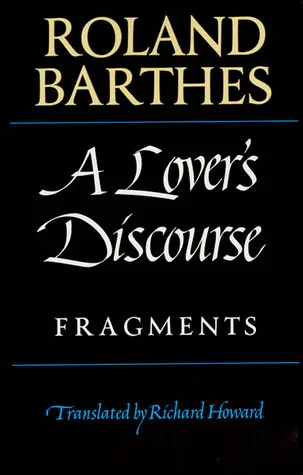
Roland Barthes organizes this text as a lexicon of the lover’s internal monologue, categorizing the erratic emotions of infatuation into alphabetical fragments called "figures." Rather than a linear narrative, the book utilizes a structuralist approach to map the solitary state of desire. Barthes draws from clinical psychology, Goethe’s "The Sorrows of Young Werther," and Zen philosophy to analyze specific moments of romantic distress, such as waiting for a phone call, the sting of an absent gesture, or the agony of gossip. He argues that the lover’s language is a code spoken in isolation, detached from the reality of the beloved person.
This book serves readers interested in semiotics, affect theory, and the mechanics of human intimacy. It attracts those who wish to deconstruct their own emotional patterns through a rigorous intellectual lens. By stripping away the sentimentality of romance, the reader identifies the underlying linguistic structures that dictate how people experience longing. One walks away with a vocabulary for the irrational and a technical understanding of how private obsession mirrors established literary and cultural archetypes.
Deep, inward-looking, contemplative and open-ended; a demanding read.
Best for readers like The Wisdom Collector. Which reader are you?
- Published
- 1977
- Language
- EN