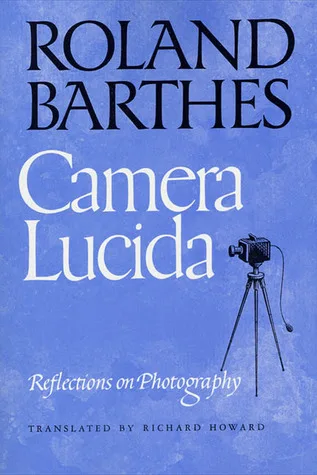
Roland Barthes examines the nature of photography through a dual framework: the studium and the punctum. The studium refers to the cultural, linguistic, and political meanings an observer recognizes in an image. In contrast, the punctum is a specific detail that breaks through this communal interest to wound or prick the individual viewer personally. Following the death of his mother, Barthes searches for her true likeness in family archives, eventually finding it in the Winter Garden Photograph. He argues that the unique essence of photography is the "that-has-been," a physical proof of a subject's past existence that connects the medium inherently to death and the passage of time.
This text attracts students of semiotics, visual artists, and those interested in the psychology of grief. Readers use Barthes’ vocabulary to move beyond technical analysis and describe why certain images provoke visceral, involuntary emotional reactions. The book provides a method for evaluating how a photograph functions as both a historical record and a private memento. A reader finishes the work with a specific lens for viewing their own family history and a critical understanding of how the camera captures a presence that is simultaneously lost.
Deep, inward-looking, contemplative and open-ended; a demanding read.
Best for readers like The Wisdom Collector. Which reader are you?
- Published
- 1980
- Language
- EN