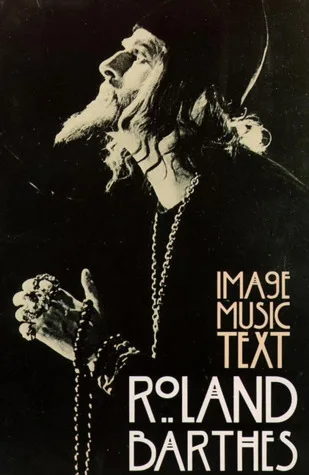
Published in 1977, this collection of essays translates Roland Barthes’s structuralist and post-structuralist inquiries into the mechanics of communication. The text centers on the concept of the death of the author, arguing that meaning originates in the reader’s destination rather than the creator’s intent. Barthes dissects the photographic message through terms like the denoted image and the connoted message, while analyzing how captions anchor or relay visual meaning. Within the sphere of music, he introduces the grain of the voice to distinguish the physical materiality of a performance from its cultural interpretation. Across these studies, he applies semiotic frameworks to disentangle the linguistic signs embedded in non-verbal media.
Students of semiotics, media theory, and art history read this book to understand how ideology functions within popular culture and aesthetics. The reader learns to identify the codes that construct narrative and visual reality. By studying these essays, an individual gains the technical vocabulary to deconstruct advertisements, films, and musical recordings. The book provides a methodology for stripping away the appearance of naturalness in cultural artifacts to reveal the underlying structures of signs and myths that shape human perception.
- Published
- 1977
- Language
- EN