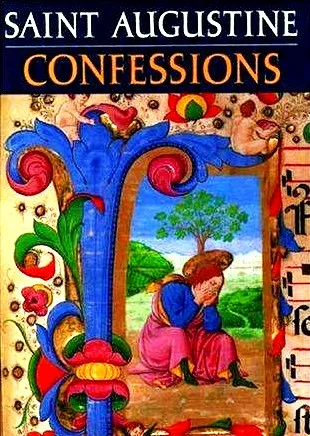
Augustine of Hippo details his transition from his youth in Roman North Africa to his appointment as a bishop. He describes his early involvement with Manichaeism and his professional life as a teacher of rhetoric in Carthage and Rome. The text recounts his intellectual struggle with the problem of evil and his move toward Neoplatonism before his eventual baptism in Milan. His narrative focuses on specific internal conflicts regarding sexual desire and the theft of pears, concluding with a dense philosophical analysis of the nature of time and the interpretation of Genesis.
This work serves readers interested in the development of Western theology and the structure of human memory. It appeals to those studying the psychological transitions of religious conversion and the history of Late Antiquity. Readers gain an understanding of the intersection between classical philosophy and early church doctrine. The book provides a technical framework for examining personal guilt and the mechanics of the human will. Those who finish the text acquire a historical perspective on how personal narrative became a tool for systematic theological instruction.
Deep, inward-looking, contemplative and open-ended; a demanding read.
Best for readers like The Wisdom Collector. Which reader are you?
- Published
- 1482
- Language
- EN
Quotes by Augustine of Hippo
More →The soul becomes dyed with the color of its thoughts.
Confessions
Grant me chastity and continence, but not yet.
Confessions
Faith is to believe what you do not see; the reward of this faith is to see what you believe.
Sermons