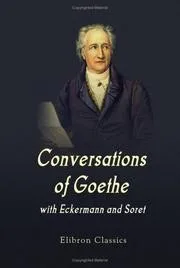
Conversations of Goethe with Eckermann and Soret
This record documents the final decade of Johann Wolfgang von Goethe's life through the meticulous chronological notes of his private secretary, Johann Peter Eckermann. The text functions as a series of intellectual dialogues covering the author’s daily routines in Weimar, his thoughts on the construction of Faust, and his observational studies in botany and color theory. These entries detail Goethe’s specific critiques of contemporary writers like Lord Byron, his theories on world literature, and his reflections on the cultural shifts occurring in post-Napoleonic Europe. It serves as a factual archive of his spontaneous opinions on aesthetics, science, and the morality of the emerging industrial age.
Historians and students of German literature read this work to observe the practical application of a polymath’s intellect during his old age. It provides a direct view into the creative process and the social interactions surrounding the Weimar Classicism movement. Readers gain a granular understanding of how Goethe synthesized classical traditions with modern scientific inquiry. The book offers a firsthand account of the internal logic and specific intellectual habits of one of Europe’s most influential thinkers, removing the abstractions often found in his formal poetry and prose.
Deep and contemplative; a moderate read.
Best for readers like The Wisdom Collector. Which reader are you?
- Published
- 1828
- Language
- EN