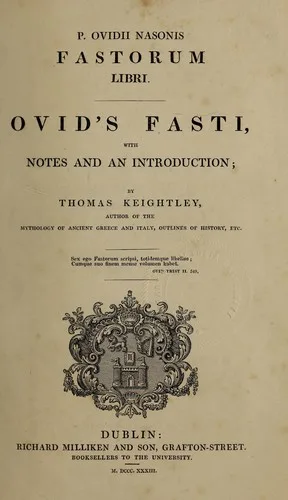
Ovid’s Fasti serves as a poetic calendar documenting the religious festivals, astronomical markers, and historical anniversaries of the Roman year from January to June. Written in elegiac couplets, the text explains the origins of specific rituals, such as the Lupercalia and the Megalensia, while detailing the movements of constellations across the night sky. Ovid utilizes interviews with deities like Janus and Mars to clarify the etymology of month names and the reasons behind traditional sacrifices. The 1482 incunable edition preserves this fusion of civic duty and mythological lore, connecting the Julian calendar to the foundation myths of the Roman state.
Historians and classicists consult this work to reconstruct the liturgical life and social structures of early Imperial Rome. Readers gain a technical understanding of the transition from the lunar to the solar calendar and the specific dates governing legal and religious activity. The text provides a direct catalog of archaic folk customs and astronomical observations used by ancient citizens to navigate their civic year. By studying these verses, a reader identifies how agricultural cycles and political propaganda influenced the public identity of the Roman people during the reign of Augustus.
Deep; a demanding read.
Best for readers like The Deep Diver. Which reader are you?
- Published
- 1482
- Language
- EN