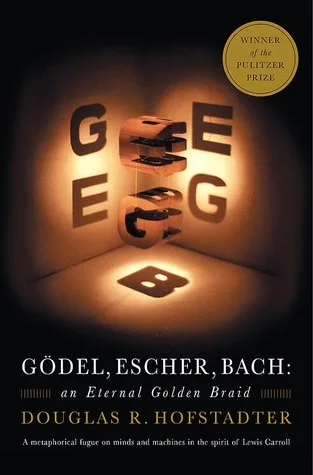
Gödel, Escher, Bach: An Eternal Golden Braid
Douglas Hofstadter explains how self-referential systems produce conscious intelligence through a framework of strange loops. He connects the mathematical theorems of Kurt Gödel regarding formal systems and incompleteness to the recursive visual paradoxes of M.C. Escher and the contrapuntal fugues of Johann Sebastian Bach. By analyzing how symbols acquire meaning from inanimate substrates, the text maps the progression from neurological hardware to psychological software. The narrative alternates between technical proofs and whimsical dialogues between Achilles and the Tortoise, illustrating how maps that fold back on themselves generate a sense of "I."
Readers Interested in artificial intelligence, symbolic logic, and cognitive science find this a rigorous exercise in pattern recognition. It attracts those who enjoy decoding hidden structures and metaphorical isomorphisms across disparate disciplines. A reader finishes the book with a technical understanding of the Halting Problem, recursive functions, and the limitations of formal logic. More broadly, they gain a mental model for how complexity emerges from simple rules, providing a perspective on the mechanical origin of human thought and subjective identity.
Deep and open-ended; a demanding read.
Best for readers like The Deep Diver. Which reader are you?
- Published
- 1979
- Language
- EN