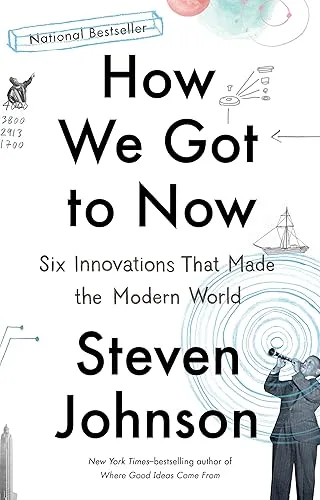
How We Got to Now: Six Innovations That Made the Modern World
In this history of science, Steven Johnson tracks the unintentional consequences of six specific technological paths: glass, cold, sound, clean, time, and light. He uses the concept of the "adjacent possible" to explain how certain inventions only become viable once preceding tools exist. The book details the "long zoom" perspective, showing how the invention of the telescope eventually led to the creation of the internet, or how the vacuum tube enabled both radio and the first digital computers. Johnson illustrates how a breakthrough in one field, such as artificial refrigeration, fundamentally reorganized human geography and global politics by making tropical climates habitable for industrial work.
Readers interested in the history of technology and systemic change find this book useful for its focus on the "hummingbird effect," where an innovation in one domain triggers an unpredictable shift in a completely different area. The text appeals to those who want to understand the physical and chemical origins of modern life rather than focusing on military or political leaders. By the end, a reader gains a framework for seeing the world as a web of interconnected discoveries where the smallest technical adjustment can reshape human evolution and daily social habits.
- Published
- 2014
- Language
- EN