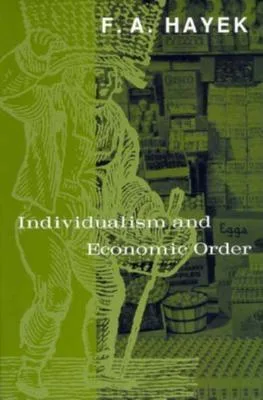
Friedrich Hayek’s collection of essays centers on the distinction between "true" individualism, rooted in evolutionary social processes, and "false" rationalistic individualism, which presumes human reason can design complex systems. Hayek argues that economic order emerges from the decentralized actions of individuals rather than central planning. He introduces the concept of the "division of knowledge," explaining that society functions because the price system communicates dispersed bits of information that no single mind or committee could ever fully possess or process.
This book serves researchers, economists, and political theorists who study the mechanics of free-market coordination. Readers gain a technical understanding of why competitive markets outperform bureaucratic management by utilizing local, tacit knowledge. The text provides a framework for evaluating how institutional rules and legal structures support spontaneous order. Those interested in the intellectual foundations of classical liberalism use these arguments to examine the limits of social engineering and the theoretical necessity of price signals in any functioning economic system.
- Published
- 1948
- Language
- EN