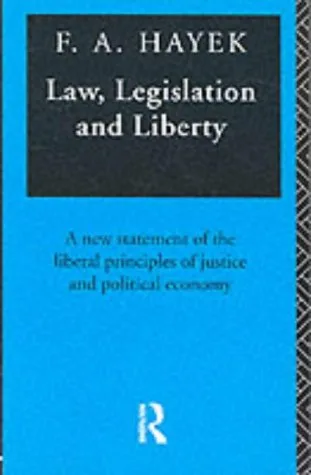
Law, Legislation and Liberty, Volume 1: Rules and Order
In this volume, Hayek distinguishes between "cosmos," the spontaneous order of a free society, and "taxis," an order created by deliberate arrangement. He argues that modern legal theory confuses law with legislation, leading to the erosion of liberty. Hayek presents law as a discovery of existing patterns of behavior rather than a product of governmental will. He analyzes "nomos" as the universal rules of just conduct that allow individuals to pursue their own goals within a predictable framework, contrasting this with goal-oriented administrative commands.
Legal scholars, political theorists, and economists read this book to understand the evolutionary development of social institutions. Readers gain a framework for identifying when government intervention disrupts the self-regulating mechanisms of market and legal systems. The text provides a technical argument for why central planning fails to account for dispersed knowledge, offering a defense of the rule of law based on procedural justice instead of specific social outcomes. Professionals in public policy use these concepts to evaluate the limits of legislative authority in a liberal order.
- Published
- 1973
- Language
- EN