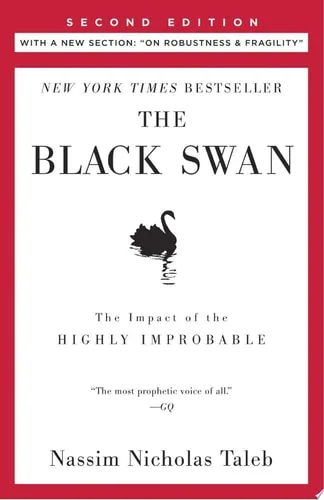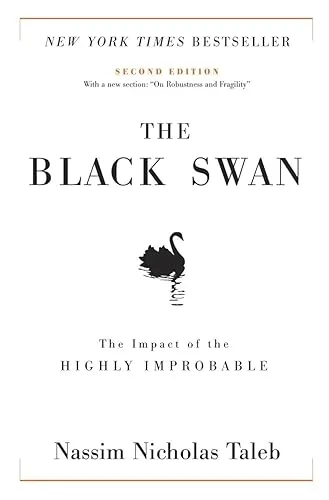
Nassim Nicholas Taleb argues that history is driven by Black Swans: unpredictable, high-impact events that are rationalized after the fact through narrative fallacy. He contrasts Extremistan, a realm of scalable variables like wealth and book sales where outliers dominate, with Mediocristan, where physical traits like height follow a bell curve and individual observations carry little weight. Taleb critiques the misuse of Gaussian statistics in finance and social sciences, asserting that professional forecasting fails because it ignores the silent evidence of past failures and the inherent randomness of complex systems.
Investors, risk managers, and analysts read this book to understand the limits of predictive modeling and the dangers of epistemic arrogance. It provides a framework for building robustness against negative shocks while positioning oneself to benefit from positive volatility. Readers learn to identify the ludic fallacy—the mistake of applying simple game-like probability to the messy realities of global markets or political crises. By the end, they gain a skeptical perspective on expert opinion and a method for navigating uncertainty without relying on flawed historical patterns.
Insights from Lebada Neagra
“Lumea noastră este dominată de evenimente extreme, necunoscute și foarte puțin probabile.”
Creierul nostru caută mereu explicații logice după ce se întâmplă ceva rău. Ne păcălim singuri că am fi putut prezice dezastrul.
Oamenii de știință ignoră adesea dovezile tăcute ale eșecului. Vedem doar supraviețuitorii, nu și cimitirul celor care au pierdut tot.
“Trăim într-o societate în care evenimentele rare sunt cele care contează cel mai mult.”
Planurile pe zece ani sunt aproape inutile în lumea reală. Un singur eveniment neașteptat poate șterge tot progresul într-o secundă.
“Problema curcanului poate fi generalizată la orice situație în care mâna care te hrănește te poate sugruma.”
Experții se înșală deseori pentru că se bazează pe trecut ca să vadă viitorul. Curcanul crede că măcelarul e prietenul lui până în ziua tăierii.
- Published
- 2007
- Language
- RO