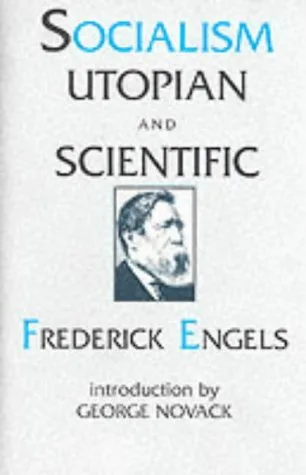
Friedrich Engels distinguishes between the idealistic blueprints of early reformers and the materialist methodology of modern socialism. He argues that thinkers like Saint-Simon and Fourier failed because they relied on abstract morality rather than analyzing economic forces. By applying the materialist conception of history, Engels tracks the transition from feudalism to capitalism and the resulting contradiction between socialized production and private appropriation. This shift creates the proletariat, a class capable of ending economic anarchy through the planned distribution of resources and the eventual dissolution of the state.
Political theorists and history students find this text useful for understanding the evolution of Marxist theory. It provides a concise explanation of how dialectics applies to social development and economic cycles. Readers walk away with a framework for analyzing the internal mechanics of capital accumulation and the structural causes of recurring financial crises. The book serves as an introduction for those wanting to differentiate between moral objections to inequality and a systemic analysis of productive relations within industrial society.
Deep and outward-looking; a moderate read.
Best for readers like The Evidence Seeker. Which reader are you?
- Published
- 1880
- Language
- EN