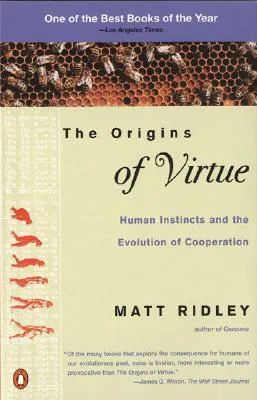
The Origins of Virtue: Human Instincts and the Evolution of Cooperation
Matt Ridley argues that human morality is a biological adaptation rooted in the logic of self-interest rather than a triumph of culture over nature. Drawing on game theory and evolutionary biology, he explains how the Prisoner’s Dilemma and the concept of reciprocal altruism drive individuals to cooperate within groups. The text analyzes how division of labor, trade, and the Tit-for-Tat strategy enabled early humans to overcome the tragedy of the commons. Ridley posits that our instincts for fairness and trust evolved because they provided a competitive edge in social landscapes.
Students of sociobiology and political philosophy read this book to understand the intersection of Darwinian selection and social behavior. It appeals to those looking for a scientific basis for human interaction that bypasses traditional sociological models. Readers gain a framework for viewing social institutions as extensions of biological drives. By the end, the reader understands how cooperation emerges from the bottom up and how individual competition can paradoxically lead to stable, collaborative societies through the mechanism of mutual benefit.
- Published
- 1997
- Language
- EN
More by Matt Ridley
See all →